Written by:
Early Neuromuscular Electrical Stimulation After ACL Reconstruction
A practical guide for physiotherapists and patients
Andreas Bjerregaard
Physiotherapist, Section of Sports Traumatology, Department of Orthopedic Surgery, Copenhagen University Hospital Bispebjerg, Copenhagen, Denmark
Dustin Maree
Physiotherapist, Rehabilitation Department, Aspetar Orthopaedic and Sports Medicine Hospital, Doha, Qatar
Abbreviations:
ACLR = Anterior cruciate ligament reconstruction
AMI = Arthrogenic Muscle Inhibition
NMES = Neuromuscular electrical stimulation
Neuromuscular electrical stimulation (NMES) after Anterior cruciate ligament reconstruction (ACLR)
Avoiding quadriceps weakness remains one of the most challenges after ACL reconstruction (ACLR). During the first few postoperative days, arthrogenic muscle inhibition (AMI), pain, and joint effusion substantially impair voluntary quadriceps activation, limiting the patient’s ability to produce an effective muscle contraction. Neuromuscular electrical stimulation (NMES) is one of the few interventions that can be introduced immediately after surgery to help restore quadriceps activation while these impairments are most pronounced.
Despite this, NMES remains underused in clinical practice, with many clinicians failing to deliver stimulation at an intensity sufficient to produce meaningful muscle activation (1). In fact, a survey of physiotherapists found that only around half were aware of existing clinical practice guideline recommendations for NMES and the therapeutic dosing (1).
Although the recent EU-US ACL Rehazilitation Consensus (2) provides a Grade B recommendation for early, high-intensity neuromuscular electrical stimulation (NMES) and the Aspetar Clinical Guidelines (3) recommends the use of NMES in the very early phase after surgery to stimulate muscle activation or minimise the expected disuse atrophy, a survey of physiotherapists found that only around half were aware of existing clinical practice guideline recommendations for NMES (1)
This article provides a practical, evidence-informed guide for physiotherapists and patients. It covers how NMES help restore quadriceps activation, where NMES sits within a criterion-based rehabilitation framework, and how to apply it effectively during the early phase of ACLR rehabilitation when AMI may be present.
The role of NMES in early ACL Rehabilitation
What is NMES?
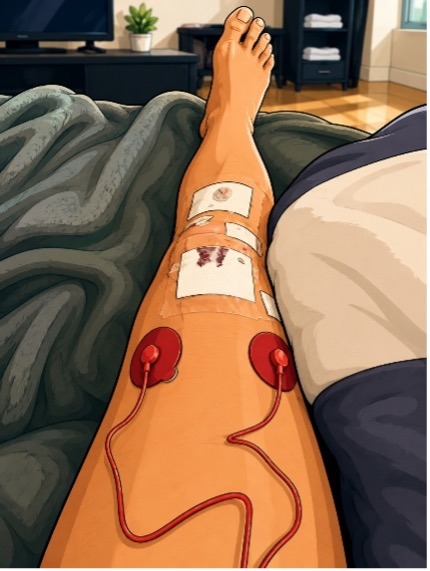
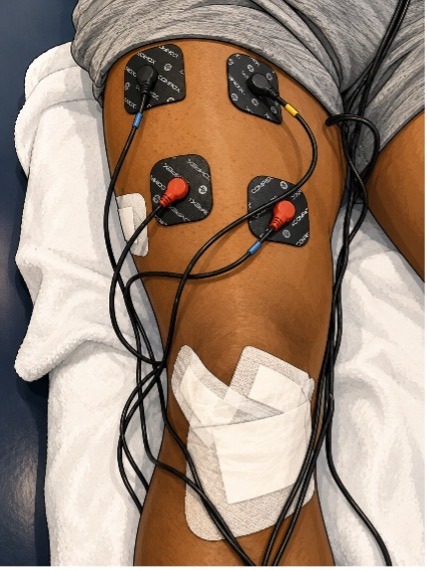
NMES works by delivering electrical current through electrodes placed on the skin overlying the quadriceps, directly depolarizing motor nerve branches and producing an involuntary muscle contraction. NMES can recruit motor units that the patient’s voluntary drive cannot access in the inhibited state (4).
This is clinically significant because, unlike voluntary contractions which may be limited by AMI, NMES bypasses these inhibitory mechanisms and facilitates quadriceps activation. NMES increases afferent input to the central nervous system and can induce spinal and supraspinal adaptations that may enhance voluntary muscle activation over time.
Patients using NMES demonstrate less reduction in quadriceps cross-sectional area and muscle thickness compared with controls, particularly when initiated within the first postoperative week (5). Beyond preserving muscle morphology, NMES enhances voluntary quadriceps activation and strength during the early postoperative period, helping patients overcome AMI when voluntary muscle recruitment is most impaired.
NMES Within the Rehabilitation Framework
The primary objective of the first six weeks after ACLR is to create the conditions for successful rehabilitation over the months that follow. The goal is to achieve what we often describe as a “happy knee”: a knee with minimal pain and effusion, full passive extension, progressive flexion, normal gait, and importantly, [ab1.1]a quadriceps that the patient can voluntarily activate.
During this phase, strength is not the primary outcome; the goal is to minimize diffuse atrophy. This is where NMES plays its most important role. NMES acts as a bridge between an inhibited quadriceps and effective voluntary muscle contraction. This is consistent with the Aspetar Clinical Practice Guideline (3), which recommends NMES as an adjunct to exercise to facilitate muscle activation and support progression towards effective strengthening.

Understanding Arthrogenic Muscle Inhibition (AMI)
What is AMI?
Arthrogenic muscle inhibition (AMI) is a reflex inhibition of the musculature surrounding an injured or surgically disrupted joint. AMI primarily affects the quadriceps and may results from a complex interaction of joint damage, pain, inflammation, joint effusion, altered sensory input, disuse, and psychological factors. Together, these mechanisms alter both spinal and supraspinal motor pathways, reducing voluntary neural drive to the quadriceps and limiting force production despite maximal effort (4, 6).
Because AMI is primarily a neurological impairment rather than simply muscle weakness, interventions that target neural activation are particularly important during the early stages of rehabilitation.
Classifying Levels of Quadriceps Activation
A clinical viewpoint (4) propose that clinicians should distinguish between three clinically meaningful levels of quadriceps activation to guide rehabilitation: A minimal, adequate, and fast activation.
- Minimal activation: The patient can perform a straight leg raise without an extension lag and can perceive a quadriceps contraction. However, activation remains inhibited and is often insufficient for weight-bearing or resisted tasks.
- Adequate activation: The patient can achieve and maintain full knee extension during the required activity and produce a high-quality voluntary quadriceps contraction throughout functional movement. This reflects sufficient activation to progressively load the quadriceps.
- Fast activation: The patient can generate force rapidly (high rate of force development), a quality that becomes increasingly important during the later stages of rehabilitation for running, plyometrics, and return-to-sport activities.
In addition, the severity of activation failure can be classified using the following clinical AMI grading system (4):
- Grade 0: Normal contraction
- Grade 1: Inhibited contraction without extension deficit
- Grade 2: Inhibited contraction with extension deficit
- Grade 3: Passive extension deficit (chronic limitation and may require surgery)
Phase 1: Early Post-Operative (Days 2–14) — Start immediately.
Rehabilitation goals: Graft protection, manage swelling, control pain, restore voluntary quadriceps activation, minimize muscle atrophy, improve passive and active knee extension, and achieve a straight leg raise without lag.
Role of NMES: This is the phase where NMES is likely to have its greatest clinical impact. During the first two postoperative weeks, AMI is at its most severe and the window for preserving muscle fiber size is narrow. At this stage, many patients are unable to generate an effective voluntary quadriceps contraction, making NMES a valuable adjunct to exercise as early as possible post-operatively.
At this stage, use NMES to:
- Facilitate voluntary quadriceps activation during and after sessions
- Maintain muscle fibre recruitment during the period of enforced rest
- Reduce the experience of joint pain (analgesic effect), allowing earlier engagement with exercise
- Support management of joint effusion
Clinical approach: Apply NMES together with isometric muscle contraction during exercises where possible. If the patient cannot yet co-contract voluntarily, passive NMES is appropriate while working toward superimposed use.
Monitoring: Assess activation quality at each session. Can the patient sustain a contraction? Is there visible VMO engagement?
Combine with cryotherapy. Cryotherapy may reduce afferent inhibitory signals from joint mechanoreceptors, temporarily lowering the AMI threshold and making NMES-evoked contractions more accessible (7). Apply ice for 15–20 minutes prior to NMES where feasible.
Phase 2: Early Strength Phase (Weeks 2–6) — Restoring Adequate Activation
Rehabilitation goals: Graft protection, manage swelling, control pain, restore voluntary quadriceps activation, minimize muscle atrophy, improve passive and active knee extension, improve knee range of motion (0–120°), and begin progressive open and closed kinetic chain exercises.
Role of NMES: Continue NMES as a rehabilitation warm-up and superimposed during strengthening exercises. This is the phase in which reaching the target intensity (≥100 mA / visible tetany) should be prioritized.
Clinical approach: Superimpose NMES during isometric quadriceps contractions at 30°, 60°, and 90° of knee flexion, terminal knee extensions, short arc quads, progressive straight leg raises with weight, and the introduction of leg press (after week 3) and squat patterns.
For hamstring tendon graft patients, NMES to the hamstrings may be introduced from approximately 6 weeks post-operatively, once the harvest site has healed and isometric hamstring loading is clinically appropriate (7). Electrode placement directly over the harvest incision should be avoided until the wound is fully closed.
Monitoring: Track activation quality subjectively (contraction visibility, patient feedback) and objectively where possible.
Combine with BFR training. NMES and BFR target different mechanisms and are appropriate to use simultaneous.

Phase 3: Progressive Strength and Function (Weeks 6–16+) — Restoring Fast Activation
Rehabilitation goals: Progressive voluntary muscle activation and rate of force development toward ≥70% limb symmetry index at 12–16 weeks when integrating running and plyometric exercises.
Role of NMES: TThe role of NMES diminishes progressively as voluntary activation improves. Traditional progressive resistance training becomes the primary driver of strength recovery. NMES may still be used in patients with persistent activation deficits or superimposed during higher-load exercises as a neuromuscular facilitation tool.
A concept that is often underemphasized in post-ACLR rehabilitation is the distinction between restoring adequate activation and restoring fast activation. Rate of force development (RFD), the speed at which force can be generated, is [ab2.1]largely determined by motor unit firing rate rather than maximal peak force and deserves dedicated focus as rehabilitation progresses.
Clinical decision-making: If a patient reaches 10–12 weeks post-operatively and still cannot produce a quality quadriceps contraction during loaded tasks, or their limb symmetry index on isometric testing remains below 70%, this is a flag for reassessment. Consider whether AMI remains a contributing factor (persistent effusion, inadequately managed pain) and maintain NMES alongside other modalities.

Practical Application: Active vs Passive application of NMES
Use the highest intensity you can tolerate. Where possible, NMES should be delivered while the patient simultaneously attempts a voluntary contraction as superimposed NMES has consistently shown superior results to passive application. A progressive NMES hierarchy can be applied (6).
- Static passive NMES: NMES [ab3.1]delivered without an active voluntary contraction, progressing the intensity until a visible contraction is achieved
- Static superimposed NMES: NMES [ab4.1]delivered with a simultaneous voluntary contraction
- Dynamic superimposed NMES: NMES delivered progressively through closed and open chain. NMES can additionally be combined with blood flow restriction.

What Physiotherapists Should Be Assessing and Monitoring
Effective use of NMES requires ongoing clinical assessment. Key markers to track:
Activation quality: can the patient produce a visible, sustained voluntary contraction? Is there VMO engagement? Does activation quality change under load?
Evoked force: the actual torque or contraction magnitude produced by the NMES stimulus. This is the major determinant of NMES effectiveness.
Intensity tolerance: How does the patient’s tolerable NMES intensity change session to session? Plateau or regression may indicate inadequate pain or effusion management
Effusion: Persistent joint effusion perpetuates AMI. Assessment with the stroke test at each session. If effusion increases with exercise load, the load is too high and AMI will worsen.
Limb symmetry index: Tracking isometric quadriceps strength symmetry provides objective data to guide NMES weaning and progression. A limb symmetry index below 70% should prompt continued or intensified NMES use.
ACLR related contraindications
NMES should not be used in patients with:
- A pacemaker or implanted electronic device
- Active blood clot (DVT)
- Active infection in the area
- Active bleeding disorder
- Cancer in the treatment area
- Untreated heart rhythm disorders (avoid chest area)
- Seizure disorders (avoid head/neck)
- Pregnancy (avoid abdomen/low back)
Clinical take away
NMES should be introduced within the first 2–3 postoperative days. Delaying NMES by several weeks misses the period when quadriceps activation failure is most pronounced and muscle atrophy develops most rapidly. Start early, progress the intensity, and integrate NMES within a structured, criterion-based rehabilitation plan.

Author: Andreas Bjerregaard
Member of: Team ACL (link)
Specialization: ACL Assessment, ACL Rehabilitation and ONLINE ACL rehabilitation

Author: Dustin Maree
Physio at: Aspetar Hospital
Specialization: ACL Assessment, ACL Rehabilitation, Cartilage injury rehabilitation
References:
- Arhos EK, Ito N, Hunter-Giordano A, Nolan TP, Snyder-Mackler L, Silbernagel KG. Who’s Afraid of Electrical Stimulation? Let’s Revisit the Application of NMES at the Knee. J Orthop Sports Phys Ther. 2024;54(2):101-6.
- Robert Prill (EU E, Thomas Patt (EU, ESSKA), Mark Paterno (US, AASPT), Volker Musahl (US, AOSSM). The Formal EU-US ACL Rehabilitation Consensus. ESSKA; American Orthopaedic Society for Sports Medicine (AOSSM); Academy of Orthopaedic Physical Therapy (AASPT). 2026:12.
- Kotsifaki R, Korakakis V, King E, Barbosa O, Maree D, Pantouveris M, et al. Aspetar clinical practice guideline on rehabilitation after anterior cruciate ligament reconstruction. Br J Sports Med. 2023;57(9):500-14.
- Moiroux-Sahraoui A, Forelli F, Mazeas J, Rambaud AJ, Bjerregaard A, Riera J. Quadriceps Activation After Anterior Cruciate Ligament Reconstruction: The Early Bird Gets the Worm! Int J Sports Phys Ther. 2024;19(8):1044-51.
- Li Z, Jin L, Chen Z, Shang Z, Geng Y, Tian S, et al. Effects of Neuromuscular Electrical Stimulation on Quadriceps Femoris Muscle Strength and Knee Joint Function in Patients After ACL Surgery: A Systematic Review and Meta-analysis of Randomized Controlled Trials. Orthop J Sports Med. 2025;13(1):23259671241275071.
- Maffiuletti NA, Gondin J, Place N, Stevens-Lapsley J, Vivodtzev I, Minetto MA. Clinical Use of Neuromuscular Electrical Stimulation for Neuromuscular Rehabilitation: What Are We Overlooking? Arch Phys Med Rehabil. 2018;99(4):806-12
- Sonnery-Cottet B, Saithna A, Quelard B, Daggett M, Borade A, Ouanezar H, et al. Arthrogenic muscle inhibition after ACL reconstruction: a scoping review of the efficacy of interventions. Br J Sports Med. 2019;53(5):289-98.

Become a member at Team ACL
Are you a doctor, a physical therapist, an athletic trainer, a mental performance coach or a scientist and do you want to increase your visibility for ACL patients and professionals?